

Avenues for Justice
100 Centre Street, Room 1541
New York, NY 10013
info@avenuesforjustice.org
©Copyright 2022 Avenues for Justice. All rights reserved.


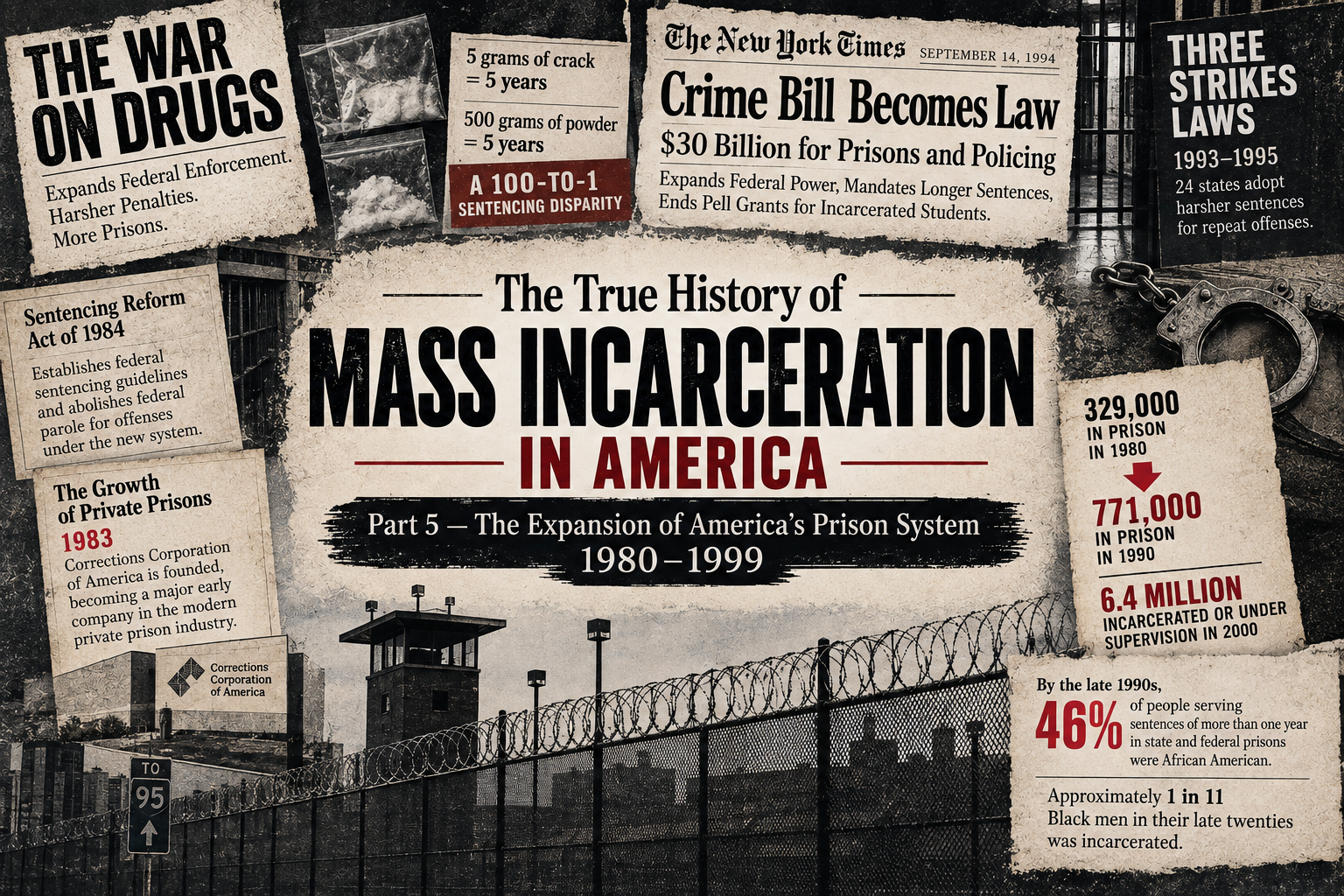
The True History of Mass Incarceration in America:
Part 5 — The Expansion of America’s Prison System | 1980–1999
In Part 4, we explored the collapse of Jim Crow laws and the movement to begin the war on drugs as a replacement effort to demonize and incarcerate Black and Brown people in the United States.
By 1980, the foundation had been laid and for the next two decades, federal and state lawmakers would build upon it—expanding the War on Drugs, imposing mandatory sentences, limiting judicial discretion and parole, increasing penalties for repeat offenses, and investing billions of dollars in policing and prisons.
The extraordinary growth of incarceration was the result of decisions about how America would respond to crime, drugs, poverty and social instability and those decisions destroyed Black and Brown communities.
The damage would accumulate across families, neighborhoods, and generations.
In 1980, approximately 329,000 people were held in state and federal prisons. By 1990, that number had grown to more than 771,000—an increase of 134% in just a decade.
The country was building more prisons, and laws and policies were sending more people to jail, increasing the length of some sentences and expanding the number of people under probation, parole and other forms of correctional supervision.
One of the most significant drivers was the escalation of the War on Drugs.
The Anti-Drug Abuse Act of 1986 established mandatory minimum sentences for certain federal drug offenses. It also created one of the most consequential disparities in modern federal drug policy: five grams of crack cocaine triggered the same five-year mandatory minimum sentence as 500 grams of powder cocaine—a 100-to-1 disparity. The resulting federal sentencing structure became one part of a larger system of drug enforcement whose consequences fell disproportionately on Black communities.
Race and punishment were becoming increasingly intertwined with which crimes were prioritized, who was arrested, how people were prosecuted and how long they were sentenced for.
At the same time, the Sentencing Reform Act of 1984 transformed federal sentencing, establishing a new sentencing guidelines system and abolishing federal parole for offenses committed after the new system took effect. Across the country, states also adopted laws designed to impose longer sentences and restrict opportunities for early release.
Between 1993 and 1995 alone, 24 states adopted new laws commonly known as “three strikes” laws, increasing sentences for people convicted of multiple serious offenses. The laws varied significantly from state to state, but they reflected a larger national movement toward longer and more certain punishment.
In 1983, Corrections Corporation of America was founded, becoming an early major company in the modern private prison industry. The emergence of private prisons did not create mass incarceration, but it reflected the enormous demand for prison capacity as incarceration expanded.
America was developing an infrastructure capable of imprisoning people on a scale that would have been almost unimaginable only a generation earlier.
The consequences for Black and Brown communities were devastating. Mass incarceration did not just remove people from their communities; it also changed the communities themselves. When thousands of people were sent to prison—disproportionately Black and Brown men—their families lost parents, partners, wage earners and caregivers. Children grew up with incarcerated mothers and fathers sometimes hundreds of miles from home. Families carried the financial and emotional burdens of maintaining contact and preparing for a loved one’s return.
By the end of the 1990s, African Americans represented 46 percent of people serving sentences of more than one year in state and federal prisons. Approximately one in every 11 Black men in their late twenties were in state or federal prison.
Mass incarceration destroyed families and communities.
By the 1990s, the policies that had been building for years were transforming the country. Three-strikes and truth-in-sentencing laws spread across the states. The 1994 Crime Bill added billions of dollars for law enforcement and prisons and eliminated Pell Grant eligibility for incarcerated students.
In 1980, about 1.8 million adults were incarcerated or under probation or parole supervision in the United States. By 2000, that number had reached nearly 6.5 million.
In some neighborhoods, incarceration became a recurring part of family life. Neighborhoods already confronting poverty, unemployment and decades of racial inequality were losing large numbers of residents to prison and then receiving them home with fewer opportunities to rebuild their lives.
By the end of the 1990s, it had become part of the structure of American life and Black and Brown communities had paid an extraordinary price.