

Avenues for Justice
100 Centre Street, Room 1541
New York, NY 10013
info@avenuesforjustice.org
©Copyright 2022 Avenues for Justice. All rights reserved.


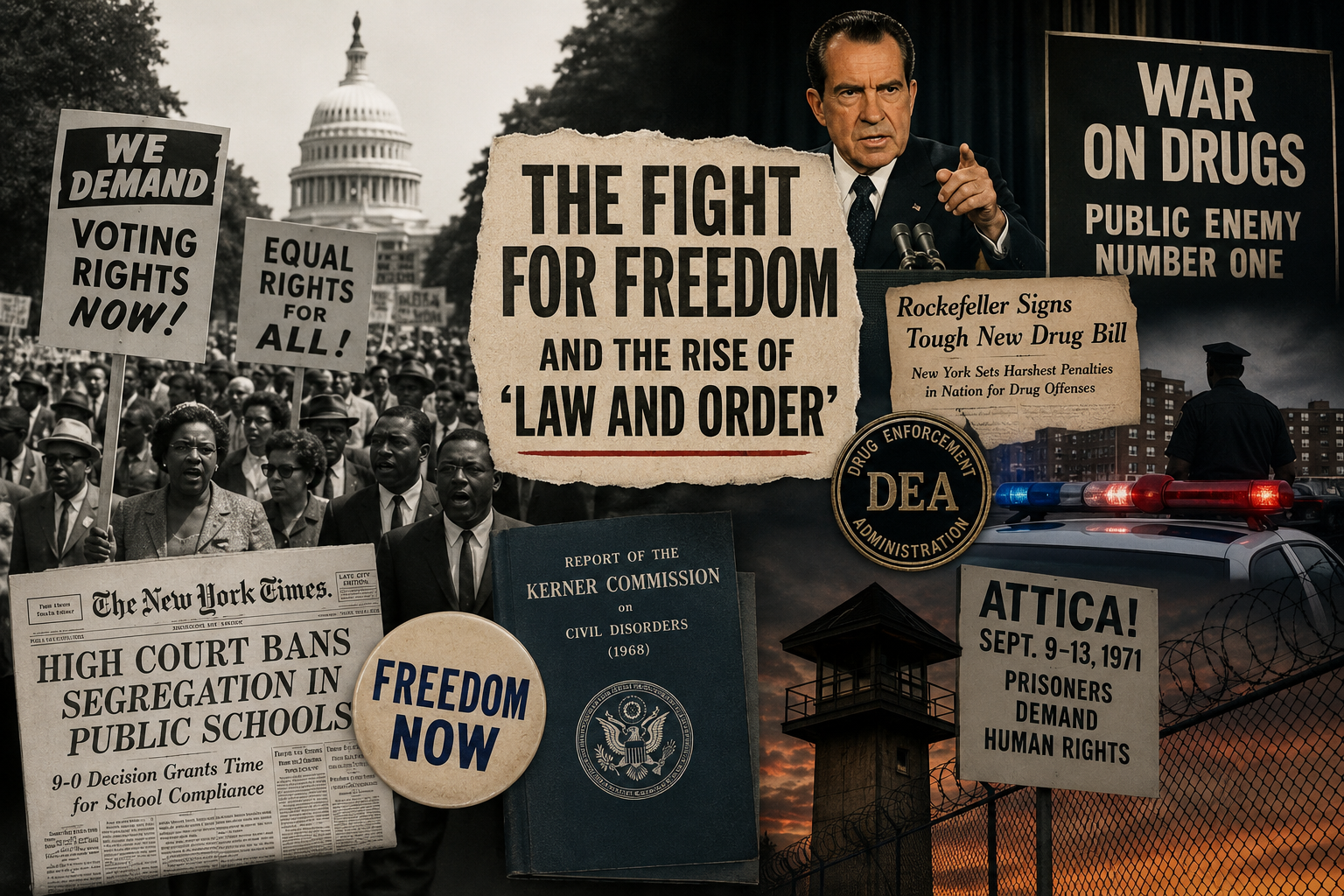
In Part 3 of our series on Mass Incarceration in America, we explored the rise of Jim Crow and how racial segregation, violence, and discrimination became deeply embedded in American institutions, including the criminal legal system.
Now, in Part 4, we turn to a moment when Black Americans were forcing the country to confront those systems and demanding change.
The 1950s through the 1970s transformed America.
In 1954, the Supreme Court ruled in Brown v. Board of Education that racial segregation in public schools was unconstitutional. Over the next two decades, Black Americans organized, marched, protested, registered voters, challenged discriminatory laws, and demanded that the country live up to its promises of freedom and equality.
The Civil Rights Act of 1964 outlawed discrimination in public accommodations and employment. The Voting Rights Act of 1965 attacked one of the most powerful tools Southern states had used to prevent Black Americans from voting. Black political participation grew dramatically.
Black America was finding and exercising its voice in ways the country could no longer ignore.
But as the Civil Rights Movement challenged segregation and racial inequality, crime and public disorder became increasingly powerful political issues. Urban uprisings in Watts, Newark, Detroit and other cities were frequently presented to the public through the language of crime and disorder. Calls for "law and order" grew louder.
In 1968, the Kerner Commission, created by President Lyndon Johnson to investigate the causes of urban unrest, identified police practices as the most significant grievance in the communities it studied. It also documented unemployment, inadequate housing and education, poverty, and discriminatory treatment within the justice system.
Yet the country was also moving toward a very different response.
The federal government began investing heavily in policing. The Law Enforcement Assistance Act of 1965 marked an important expansion of federal involvement, followed by the Omnibus Crime Control and Safe Streets Act of 1968, which directed hundreds of millions of federal dollars toward state and local law enforcement.
Black activism itself was also being subjected to government surveillance. In 1967, the FBI expanded its controversial COINTELPRO program to include the Black Panther Party. The FBI later acknowledged that agents infiltrated organizations, attempted to create conflict within them, and sought to discredit activists, sometimes despite little or no evidence of illegal activity.
Then came the War on Drugs.
In 1971, President Richard Nixon declared drug abuse "public enemy number one." Decades later, Nixon adviser John Ehrlichman described the administration's political strategy in stark racial terms, saying that associating Black people with heroin and antiwar activists with marijuana allowed the government to criminalize both heavily and disrupt those communities.
New York soon became an early testing ground for increasingly punitive drug policy. In 1973, Governor Nelson Rockefeller signed laws imposing some of the harshest drug sentences in the country, including mandatory indeterminate life sentences for certain drug offenses. Other states followed with tougher sentencing laws.
But people inside prisons were also demanding change.
In September 1971, incarcerated men at Attica Correctional Facility took control of the prison and demanded better living conditions, political rights, religious freedom and more humane treatment. The uprising became a defining event in the growing prisoners' rights movement and brought national attention to conditions inside American prisons.
By the middle of the 1970s, the nation's prison population began what the Bureau of Justice Statistics would later describe as a "dramatic rise" beginning in 1974. In 1970, approximately 196,000 people were held in state and federal prisons. By 1980, that number had grown to nearly 330,000.
Black Americans had fought successfully to dismantle laws explicitly designed to exclude them. They had secured voting rights, challenged segregation, built political organizations, and forced the country to confront racism in its institutions.
But racial inequality did not simply disappear when Jim Crow laws fell.
The institutions and language were changing. Increasingly, debates about race, poverty, protest and inequality were also becoming debates about crime, drugs, policing and punishment.
By the 1970s, the infrastructure that would make mass incarceration possible was strategically being built.
● 1954 — Brown v. Board of Education: The Supreme Court rules racial segregation in public schools unconstitutional.
● 1963 — Gideon v. Wainwright: The Supreme Court establishes the right to appoint counsel for criminal defendants who cannot afford an attorney. Chronic underfunding would later make that promise difficult to fulfill in many jurisdictions.
● 1964–1965 — Landmark Civil Rights Laws: The Civil Rights Act and Voting Rights Act dismantle major legal barriers to Black participation in American life.
● 1965 — Federal War on Crime Expands: President Johnson signs the Law Enforcement Assistance Act, increasing the federal government's role in state and local law enforcement.
● 1967 — Black Activism Under Surveillance: The FBI expands COINTELPRO to target the Black Panther Party.
● 1968 — Kerner Commission: The commission identifies police practices, unemployment, inadequate housing and discriminatory justice as major grievances behind urban unrest.
● 1968 — Federal Investment in Policing: The Omnibus Crime Control and Safe Streets Act directs $400 million toward law enforcement and establishes a major federal funding structure for state and local criminal justice systems.
● 1971 — Attica: Incarcerated people demand improved conditions and rights, helping galvanize the modern prisoners' rights movement.
● 1971 — War on Drugs: President Nixon declares drug abuse a national enemy as drugs and crime become increasingly central to federal policy and political rhetoric.
● 1973 — Rockefeller Drug Laws: New York adopts extraordinarily severe mandatory penalties for drug possession and sale.
● 1973 — DEA Created: The federal government consolidates drug enforcement under the new Drug Enforcement Administration.
● 1974 — Prison Population Begins Dramatic Rise: Federal statistics identify 1974 as the beginning of a dramatic increase in the nation's prison population.