

Avenues for Justice
100 Centre Street, Room 1541
New York, NY 10013
info@avenuesforjustice.org
©Copyright 2022 Avenues for Justice. All rights reserved.


In Part 5, we unpack the dramatic increase in incarceration and racialized discrimination in the criminal justice system during the 80s and 90s due to thethree-strikes law, the war on drugs, and more.
By the beginning of the twenty-first century, the United States had built one of the largest prison systems in the world. Decades of increasingly punitive sentencing laws, aggressive policing, and the War on Drugs had transformed the criminal legal system, with consequences that disproportionately affected Black and Brown Americans.
The history of mass incarceration is the story of how Black and Brown people have been perceived, portrayed, policed, prosecuted, and punished. Throughout American history, Black men in particular have been portrayed as dangerous, violent, and inherently criminal. These stereotypes helped justify discriminatory laws, unequal treatment in the courts, and harsh policing practices. As the country entered the 2000s, those perceptions continued to influence public attitudes and debates about crime and punishment.
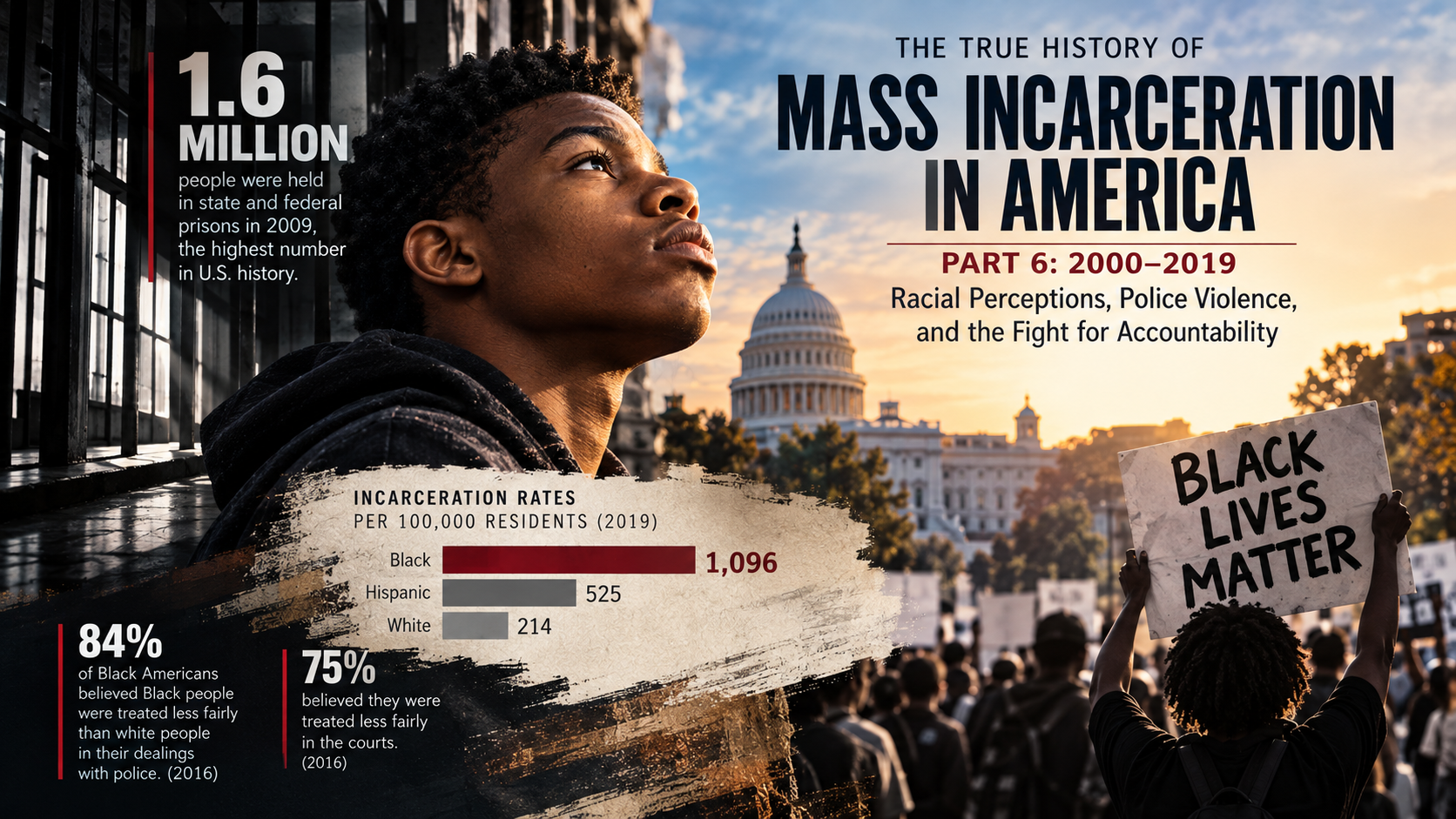
By 2009, the number of people held in state and federal prisons had reached approximately 1.6 million, according to the Bureau of Justice Statistics. Although that population would begin to decline, the racial disparities remained substantial.
In 2008, Barack Obama became the first Black president of the United States. His election represented a historic achievement, particularly for a country whose laws had denied Black Americans full political participation for much of its history. For many Americans, Obama's election created a sense of optimism about the future of race relations. Some viewed his victory as evidence that the country was moving beyond its history of racial discrimination. But the election of a Black President did not eliminate racism or the inequalities embedded in American institutions.
Obama's presidency was accompanied by racial hostility, including false claims about his citizenship and attacks on his legitimacy. These narratives circulated through political commentary, traditional news outlets, and an expanding social media environment. While political disagreements about his administration were varied, some of the attacks drew directly upon longstanding racial prejudices.
By 2016, the divide between perceptions of racial progress and the experiences of Black Americans was evident in national research. A Pew Research Center survey found that 61 percent of Black Americans believed race relations were generally bad. Eighty-four percent believed Black people were treated less fairly than white people in their dealings with police, while 75 percent believed they were treated less fairly in the courts.
The findings showed that even with the election of the country's first Black president, most Black Americans still experienced systemic inequality from the very institutions responsible for administering justice.
The consequences of racial perceptions were particularly visible in policing, as demonstrated by New York City's controversial stop-and-frisk program. This practice forced hundreds of thousands of citizens—predominantly Black and Brown residents—into contact with law enforcement, peaking at roughly 686,000 recorded stops in 2011.
While these encounters did not necessarily lead to incarceration, they exposed deeper systemic issues. They raised fundamental questions about how suspicion was established, whose behavior was considered threatening, and how racial assumptions could shape decisions made by law enforcement.
These encounters did not necessarily lead to incarceration. But they raised fundamental questions about how suspicion was established, whose behavior was considered threatening, and how racial assumptions could shape decisions made by law enforcement.
In 2012, the killing of 17-year-old Trayvon Martin in Sanford, Florida, brought these questions into national focus. Martin was walking back from a convenience store when he was followed and fatally shot by George Zimmerman, a neighborhood watch volunteer. Zimmerman was acquitted of murder and manslaughter charges in 2013. Although Martin was not killed by a police officer, his death became central to a national conversation about racial profiling, perceptions of Black boys as threats, and the consequences of those perceptions. His killing also occurred at a time when social media was transforming how Americans received information and responded to injustice. For generations, television networks, newspapers, and other traditional media had exercised enormous influence over the portrayal of Black Americans. Social media created new opportunities for individuals to challenge those portrayals, share their experiences, and organize public responses. But it also created new opportunities for misinformation, racial stereotypes, and misleading accounts to circulate rapidly.
The scale of the transformation due to social media was significant. According to Pew Research Center, approximately 995 million tweets about race were posted between January 2015 and March 2016, averaging roughly 2.1 million each day. Social media changed the speed at which racial narratives could spread and the number of people who could participate in shaping them.
Following Zimmerman's acquittal in 2013, Alicia Garza, Patrisse Cullors, and Opal Tometi helped establish what became the Black Lives Matter movement. The movement gained greater national visibility in 2014 following the police killing of Michael Brown, an unarmed 18-year-old Black man, in Ferguson, Missouri. That same year, Eric Garner died after a New York City police officer placed him in a prohibited chokehold during an arrest on Staten Island. Garner's repeated statements that he could not breathe were captured on video, which circulated widely and brought national attention to the circumstances of his death.
In Cleveland, 12-year-old Tamir Rice was fatally shot by a police officer while playing with a pellet gun. In 2015, Freddie Gray died from injuries sustained while in police custody in Baltimore. These deaths joined earlier cases, including the police killings of Amadou Diallo in 1999, Sean Bell in 2006, and Oscar Grant in 2009, in raising questions about police use of force, racial profiling, and accountability. Not every case involved the same circumstances or legal findings. But collectively, they intensified public scrutiny of how Black men and boys were perceived and treated during encounters with law enforcement. They also exposed the limitations of public accountability. Criminal charges against officers were uncommon in many high-profile cases, and convictions were even less frequent. Families and communities repeatedly questioned whether the legal system valued Black lives equally.
These cases became national stories, but there are many experiences of people whose encounters with law enforcement never received public attention.
In 2016, Pew found that 47 percent of Black adults reported that someone had acted suspicious of them because of their race or ethnicity during the previous year. Among Black men, that figure was 52 percent. Twenty-two percent of Black men reported having been unfairly stopped by police during the same period.
Public pressure for Criminal Justice Reform was Growing
The Second Chance Act of 2008 expanded federal support for programs intended to help formerly incarcerated people return to their communities. The Fair Sentencing Act of 2010 reduced the federal sentencing disparity between crack and powder cocaine offenses, a disparity that had disproportionately affected Black defendants.
In 2018, the FIRST STEP Act introduced additional federal sentencing and prison reforms, including opportunities for some incarcerated people to earn time credits toward earlier transfer from prison.
These reforms represented changes in federal policy, but they did not eliminate the larger structures of incarceration, particularly because most incarcerated people were held under state rather than federal authority.
By the end of 2019, approximately 1.43 million people remained in state and federal prisons. The population had declined by 11 percent from its 2009 peak, and the imprisonment rate had fallen for eleven consecutive years.
Yet the racial disparities remained striking. In 2019, the imprisonment rate for Black Americans was 1,096 per 100,000 residents, compared with 525 for Hispanic Americans and 214 for white Americans. Black residents were imprisoned at more than five times the rate of white residents.
The decline in incarceration was meaningful, but it did not erase the consequences of decades of punitive policies, nor did it resolve the racial inequalities that had shaped the system.
By 2019, the United States had experienced the election of its first Black president, the emergence of a powerful movement challenging racial injustice, and growing public scrutiny of policing and the criminal legal system.
Although incarceration rates had begun to decline, racial disparities persisted, and greater public awareness had not necessarily resulted in equal treatment or accountability.
The country had made progress, but the longstanding relationship between race, criminalization, and punishment remained deeply embedded in American institutions.
As the nation entered 2020, these unresolved issues would become the focus of an unprecedented national and global reckoning.