

Avenues for Justice
100 Centre Street, Room 1541
New York, NY 10013
info@avenuesforjustice.org
©Copyright 2022 Avenues for Justice. All rights reserved.


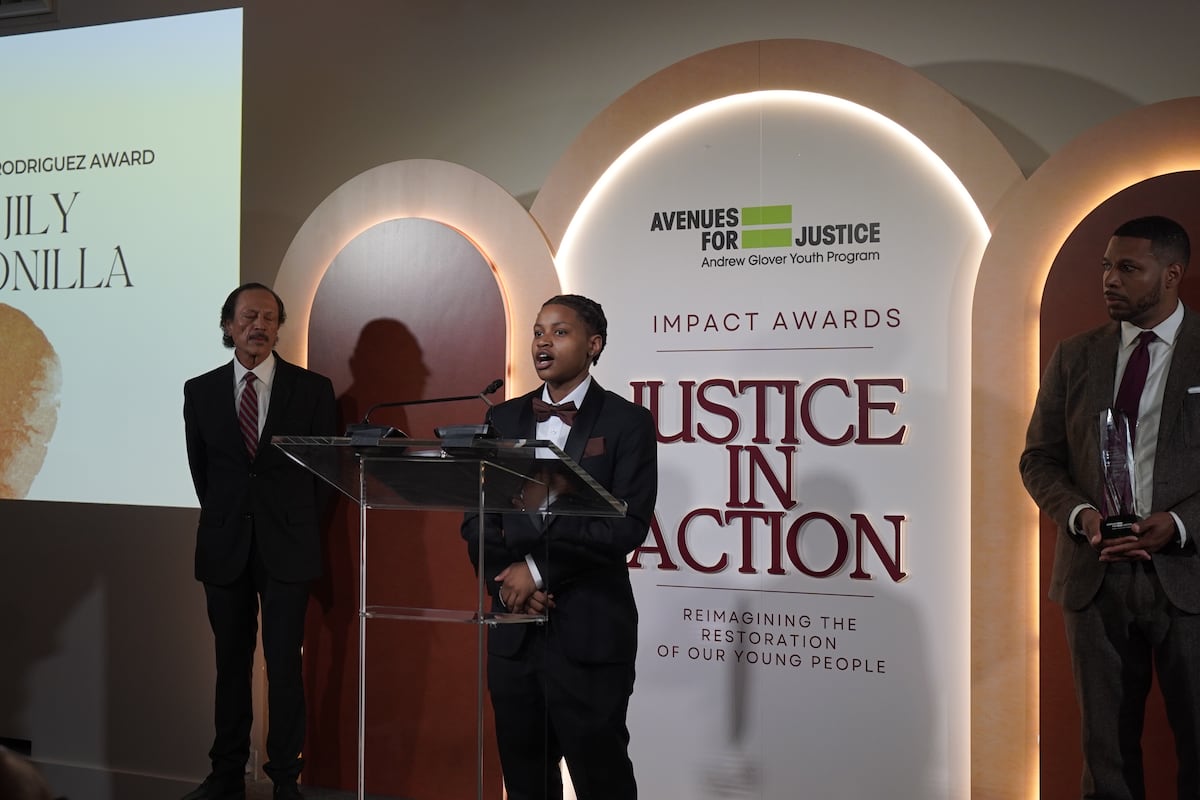
By Olivia Ta • October 28, 2026 at 8:24 PM
When Jily Bonilla addressed more than 200 attendees at Avenues for Justice’s annual Impact Awards Dinner on Oct. 14, she recalled nearly missing her first meeting with the organization out of fear. After a legal incident at age 17, Bonilla had been referred to AFJ’s diversion program, which provides court-involved youth with an alternative to incarceration through court-mandated programming and support services.
Bonilla thought she was “in trouble” again. Instead, she completed the eight sessions required of her and returned to the organization’s Harlem community center. More than two years later, she received the Angel Rodriguez Award at the nonprofit’s gala at Tribeca 360.
Officially founded in 1979 as the Andrew Glover Youth Program, Avenues for Justice provides court advocacy, educational assistance, mentorship, and workforce development opportunities to court-involved and at-risk youth between the ages of 13 and 24. The organization operates in community centers on the Lower East Side and East Harlem, alongside offices inside the Manhattan Criminal Courthouse.
The gala, themed “Justice in Action,” recognized James Cadogan, Law ’06, executive director of the National Basketball Social Justice Coalition, with the Andrew Glover Justice Award. The event also granted the Corporate Impact Award to Rick Trepp, founder and CEO of the Rockport Group and longtime AFJ board treasurer.
Cadogan, whose coalition brings together the NBA, National Basketball Players Association, and the National Basketball Coaches Association to advocate for criminal justice reform, emphasized the importance of investing in community-based programs that support young people involved in the justice system such as AFJ.
“We should invest as much as we can in those kinds of alternatives to incarceration and alternatives to arrest,” Cadogan said in an interview with Spectator.
Cadogan described the award as recognition of the organizations and teams he has worked with throughout his career.
AFJ traces its origins to Robert Siegal, a New York University student who began providing young people on the Lower East Side with a place to study and socialize in 1974. Siegal later partnered with Andrew Glover, a New York City police officer, and Angel Rodriguez, then-youth counselor at the Boys’ Club of New York, to advocate for young people facing criminal charges.
Throughout his career, Rodriguez has encouraged judges and prosecutors to consider circumstances that might contribute to an arrest, including poverty, unmet needs, and substance use.
Following Siegal’s death in 1978, Rodriguez continued developing the program, changing the name in 1979 to honor Glover, who was killed in the line of duty in 1975. The organization established offices inside the Manhattan Criminal Courthouse in 1980 and expanded to East Harlem in 1999, eventually serving participants from all five boroughs.
The organization’s HIRE UP program extends services through educational support, job -readiness training, paid internships, and workshops addressing mental health, personal development, and legal rights. At the gala, staff members also highlighted art therapy, self-advocacy activities, and a youth violence prevention initiative focused on conflict resolution and mentorship.
According to AFJ, the organization served 691 young people in 2025, and, by the time of the gala, had served more than 650 individuals in 2026. It reports that, on average, 94 percent of court-involved participants who successfully complete their court mandates are not convicted of a new crime within three years of enrollment in the program.
For Bonilla, the organization’s approach provided support that continued after her legal case was dismissed.
In the summer of 2023, Bonilla was referred to AFJ’s Family Court Diversion program. Despite her initial hesitation, she developed relationships with staff members and continued visiting the Harlem community center after completing her court obligations.
“I knew I could walk through those doors and be myself,” Bonilla said during her acceptance speech.
Over the past two years, Bonilla has completed more than 80 workshops covering leadership, legal rights, personal development, and workforce readiness. She earned occupational safety certifications, including OSHA-30, site safety, flagger, and security certifications, and served on AFJ’s leadership council.
Through AFJ’s workforce development program, Bonilla completed three internships at Braided, a Brooklyn-based hair salon, and gained employment experience at the U.S. Open through The Nourish Spot, before securing a position at Juice Press in Manhattan.
AFJ staff also supported Bonilla as she worked toward finishing high school. With assistance from job developer Shantel Brooks, Bonilla received academic credit for an internship, taking her closer to her diploma.
“She wanted to graduate, and she did it. She wanted a job, and she got several,” Brooks said in a profile published by AFJ before the gala.
Bonilla graduated high school in June 2025, an accomplishment she had previously doubted she would achieve. During her acceptance speech, she recalled how AFJ staff members helped decorate her graduation cap and attended her ceremony.
“I chose to keep showing up. I chose to learn, I chose to work, and I chose to finish high school and go to college,” Bonilla said.
Rodriguez, who presented Bonilla with the award bearing his name, recalled urging judges to consider the circumstances that could lead young people into the criminal justice system.
“Maybe there’s a need at home. Maybe they need food. Maybe something else is going on,” Rodriguez said.
He also credited AFJ’s staff and executive director Elizabeth Frederick with continuing the organization’s work beyond its early courtroom advocacy efforts.
Brian Buckmire, a New York City public defender and the evening’s host, compared AFJ’s staff to coaches and mentors who help young people navigate difficult circumstances.
“As a public defender, we often say it is a horrible thing for a person to be defined by their worst moment, by their biggest struggle,” Buckmire said, encouraging attendees to recognize the importance of consistent support.
In an Oct. 22 reflection on the gala, Frederick wrote that AFJ carries out its programming with a staff of 13 people, whose responsibilities span court advocacy, career development, and supporting participants through educational and personal challenges.
Cadogan similarly emphasized the benefits of investing in young people beyond the courtroom. He described his coalition’s approach to advocacy as “awareness plus action equals impact,” arguing that educating communities about criminal justice issues must be accompanied by efforts to advance policy reform.
For Bonilla, AFJ’s support has shaped her ambitions beyond the organization. Now, simultaneously working and pursuing higher education, she hopes to eventually establish her own business and create opportunities for her family and others.
Reflecting on her experience at the gala, Bonilla said AFJ had helped her understand that her legal involvement as a teenager did not have to determine the rest of her life.
She concluded her acceptance speech by saying that she was no longer defined by the mistake she made at 17, but was instead “proud of the person I’m becoming.”