

Avenues for Justice
100 Centre Street, Room 1541
New York, NY 10013
info@avenuesforjustice.org
©Copyright 2022 Avenues for Justice. All rights reserved.


Rahul Babu·September 29, 2026
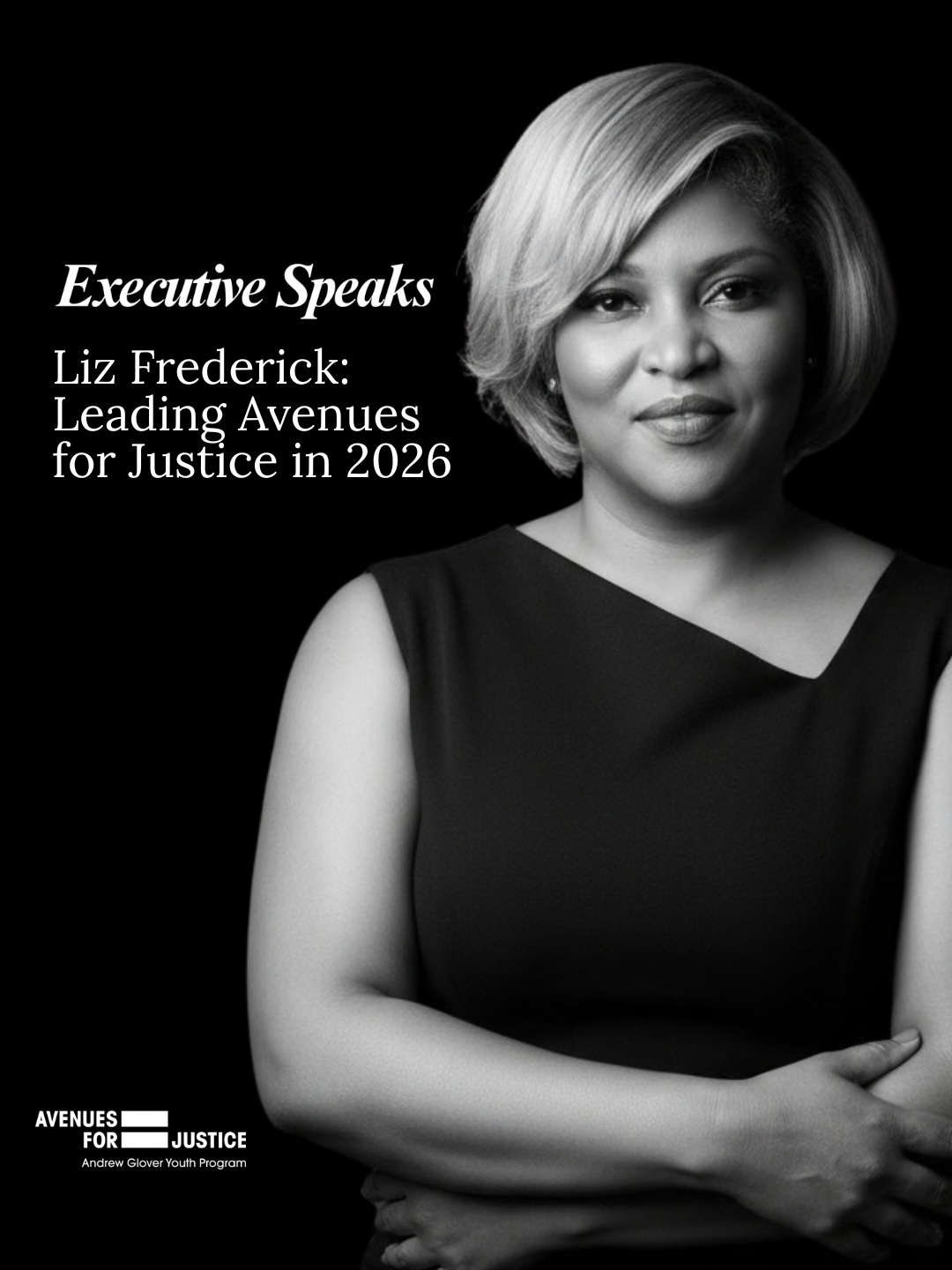
Liz Frederick is spending much of 2026 dealing with a problem that says a great deal about the reality of nonprofit leadership: the need for her organization's services is growing while finding the money to provide them has become harder.
As Executive Director of Avenues for Justice (AFJ), Frederick leads a New York City organization that works with court-involved and at-risk young people through court advocacy, education, employment, mentoring and other support. AFJ reports that it served 692 young people in 2025, its highest number to date. Its current mission remains focused on diverting young people from incarceration and creating opportunities that can help them move forward.
For Frederick, this is what “Justice in Action,” AFJ's 2026 theme, means in practice. It is less about discussing reform in the abstract and more about what happens when a young person actually needs help.
Frederick has been unusually candid about the financial pressure surrounding that work.
In a 2026 interview, she said AFJ lost $600,000 in funding during the previous year and that 98% of her time was being consumed by fundraising. At the same time, the organization was seeing greater demand for its services.
That tension has become part of Frederick's job.
She is not only responsible for the programs AFJ delivers. She also has to make the case to funders, public officials and community partners for why those programs deserve continued investment.
One recent development gave that effort some momentum. In February 2026, AFJ received a $250,000 federal grant to support its HIRE Up program, which connects formerly incarcerated young people with workforce development and job-readiness training. Frederick and Congressman Dan Goldman had been pursuing federal funding for three years.
HIRE Up is one example of how AFJ's current work extends beyond the courtroom.
The program combines employment and education opportunities with other forms of support. AFJ also provides court advocacy and wraparound services through its community-based model, with the aim of addressing circumstances that can affect whether a young person remains connected to education, work and the community.
That approach has been part of AFJ's development for years. The organization launched HIRE Up in 2020 and expanded it into education, employment and mental-health programming. It later introduced paid internships with local businesses.
Frederick's current role is to keep developing that model while making sure the organization can sustain it.
She has also pointed to AFJ's reported outcomes when making the case for alternatives to incarceration. The organization says that, on average, 94% of court-involved participants who successfully complete their court mandate are not reconvicted of a new crime within three years of enrollment. AFJ also reports an average annual cost of about $8,900 for its wraparound services for a participant.
Frederick's relationship with AFJ is unusually long.
She joined the organization in 2006 while studying for her master's degree in criminal justice at John Jay College of Criminal Justice. A short introductory meeting with AFJ co-founder Angel Rodriguez became a much longer conversation about the gap between criminal-justice theory and the experiences of people living through the system.
She stayed.
Over the following 18 years, Frederick worked through different parts of the organization before becoming Chief Operating Officer in 2020. In 2024, the board appointed her Executive Director, succeeding Rodriguez.
That history gives her a perspective that a newly arrived executive would not have.
She has seen AFJ from operations, programming, fundraising and organizational leadership. Now she is responsible for deciding what the next chapter should look like.
Frederick does not describe that transition as an attempt to fill someone else's role.
Her own explanation is memorable: “I do not need to fill someone else’s shoes. I wear my own. I like my shoes. I have earned them.”
It is more than a line about confidence.
Her leadership philosophy is built around developing other people too. She describes one of the best pieces of advice she received as, “bosses have titles and leaders have people.” She wants members of her team to develop enough professionally to move forward, whether that eventually means staying with AFJ or advancing elsewhere.
That approach fits the organization's current needs. AFJ is growing its reach while working within a difficult funding environment, so leadership cannot rest entirely with one person.
Frederick's current writing shows that she is also thinking about the larger systems surrounding the young people AFJ serves.
In a January 2026 reflection, she wrote about AFJ's work with Black and Brown court-involved and at-risk young people and argued that justice cannot be separated from community resources, opportunity and sustained investment.
She has also written about the tension between telling the truth about systemic inequities and raising money in a philanthropic environment where organizations can feel pressure to soften those realities. Her March 2026 article, Raising Money While Silencing Truth, addresses that tension directly.
It is an issue that sits close to her current responsibilities.
Frederick has to raise money while remaining clear about who AFJ serves and why its work is necessary.