

Avenues for Justice
100 Centre Street, Room 1541
New York, NY 10013
info@avenuesforjustice.org
©Copyright 2022 Avenues for Justice. All rights reserved.


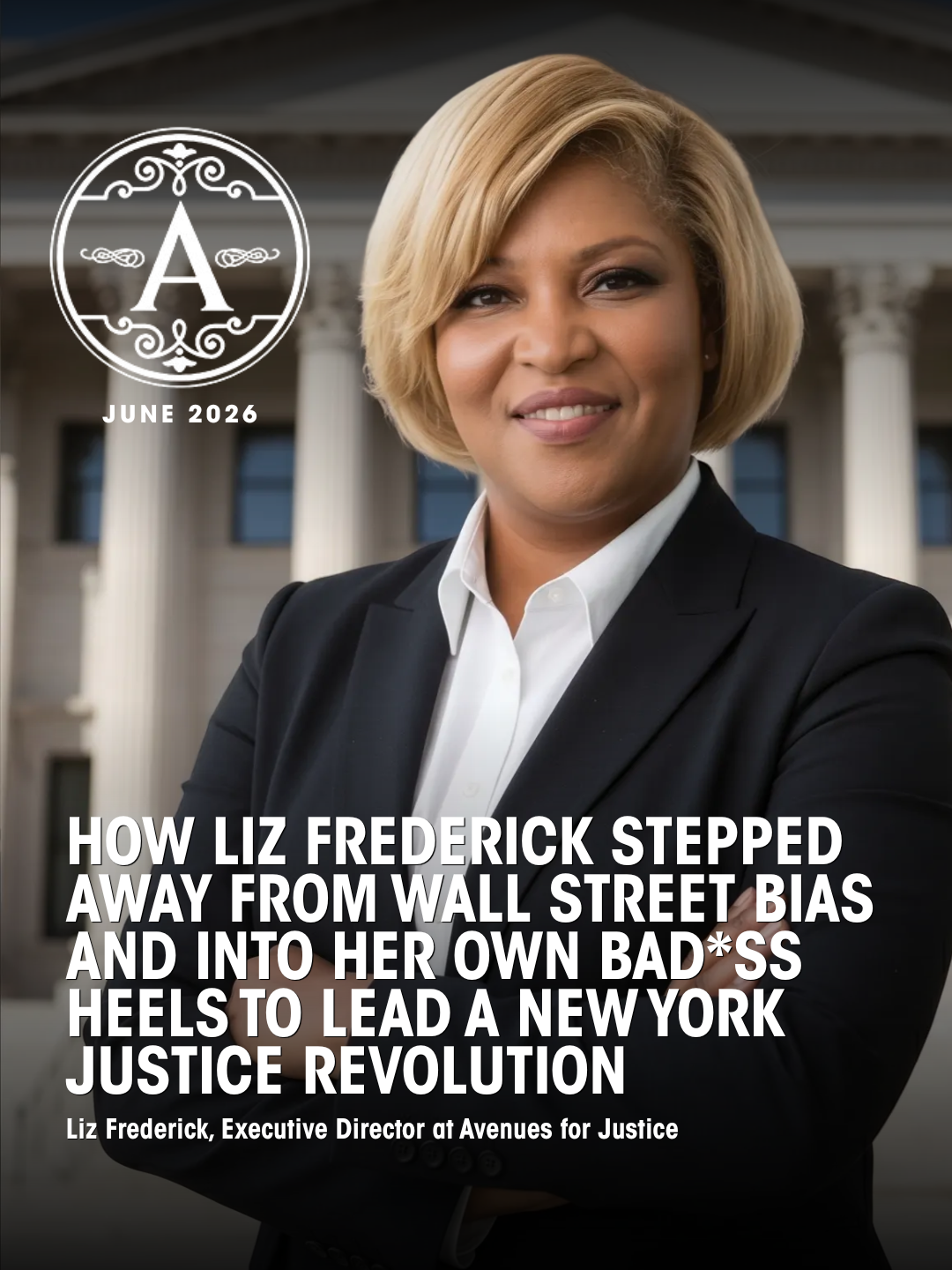
“No, I like my shoes. I’ve earned my shoes, and these shoes are going to help me carry the organization forward.”
I had the pleasure of talking with Liz Frederick. Long before she was navigating the high-stakes world of New York City’s legal system, Frederick was a child of the world. Because of her father’s work with a United Nations organization focused on women and children, she left New York at a young age, moving through the vastly different landscapes of various countries. This global childhood left a permanent mark on her character. From a very young age, she knew that she wanted to do something along the lines of empowerment and giving voices to populations that typically go unheard or unseen.
When she returned to the United States for college and eventually moved back to New York City in 2000, her first encounter with the job market was a stark introduction to systemic bias. Walking into an interview on Wall Street, the interviewer called her name, but looked right through her when she answered. The interviewer looked down at his clipboard and said, “No, Elizabeth Frederick.” When she confirmed her identity again, the corporate door effectively closed in her mind. It was at that moment she decided that was the sector she wanted to avoid, because he was clearly associating her name with how she looked. That single, unsettling experience shifted her career trajectory entirely, pushing her away from corporate finance and directly into the nonprofit field, where she has now spent 26 years fighting for social justice.
In 2006, while studying juvenile delinquency for her master’s degree at John Jay College, Frederick’s research brought her to Manhattan Criminal Court. There, she sat down with Angel Rodriguez, the legendary Co-Founder of Avenues for Justice, an organization that had been working with youth in the Lower East Side since the late 1970s. A brief 30-minute interview turned into a heavy, two-hour conversation about the realities facing kids caught in the legal system. Listening to Angel’s passion about his work and how he recognized that young people were getting into trouble during the peak after-school hours drew her in completely. She knew right then that she wanted to be part of the movement.
Frederick began her journey at the organization in operations, later mastering fundraising as development manager, before the board unanimously elected her Chief Operating Officer in 2020. Taking the operational reins right at the onset of the pandemic meant surviving an unprecedented crisis. When the city’s education system moved online, Frederick realized administrators were ignoring the digital divide affecting underresourced neighborhoods. The organization stepped in to provide internet and Wi-Fi to youth who lacked basics at home, while simultaneously building their HIRE Up program to move court advocacy and wraparound services to a hybrid platform. By 2024, when Rodriguez retired, Frederick beat out nearly 200 other applicants to become the Executive Director.
Stepping into the shoes of a founder who had led the organization for 45 years came with intense scrutiny from the New York legal community. People constantly reminded her of the legacy she had to live up to. During court appearances for arraignments, lawyers and colleagues repeatedly told her she had big shoes to fill. One afternoon, an attorney openly questioned how the organization could even function without its founder. Frederick, who happened to be wearing a pair of badass heels that day, looked down at her shoes and told him that she liked her own shoes, she had earned them, and those shoes were going to help her carry the organization forward.
Today, Frederick leads a lean team of eleven individuals who live in the very same neighborhoods as the young people they serve. Operating out of community centers in Harlem and the Lower East Side, along with courthouse offices in the Manhattan Criminal Court building, the organization works with close to 700 young people annually, splitting them into Court-Involved youth and a Preventative population. Frederick consciously rejects the standard language of the bureaucratic state when describing these teens. Other groups often refer to them as “at-risk,” but she explicitly moves away from that terminology because “at-risk” connotes a risk of failure. To her, it is truly a preventative population-which is the center of alternative to incarceration work
The core strategy relies on intense, individual stabilization by providing a continuum of care with court advocacy and holistic, wraparound services for job readiness, education, and mental health wellness. Rather than shuffling teenagers between multiple case managers and social workers, each youth is paired with a single Court Advocate who remains their constant support system for the duration of their stay. That Court Advocate becomes everything to that young person. This consistency has helped the organization maintain a 94 percent success rate, meaning the vast majority of their youth are not reconvicted of a crime within three years of enrolling.
The human impact of this model is clear in the story of Kat, a young woman from a crowded apartment in the Bronx who was facing five to seven years in prison. After meeting an advocate in court, the judge mandated her to the program. Kat immersed herself into the workshops, completed three paid internship cohorts with local businesses, and eventually secured long-term employment as a teacher’s assistant with the Department of Education. Last year, she got her own apartment. Frederick points out that if Kat had been incarcerated, she would have missed the prime of her adulthood, only leaving prison at age 27. Seeing everything she accomplished through the program was phenomenal.
Yet, keeping this work alive is increasingly difficult in a shifting political and economic climate. Frederick notes that many modern philanthropic organizations are scaling back their financial support for racial justice initiatives, even as society seems to be regressing toward a rigid “law and order” mindset. For Frederick, the long-term mission is to shift public perception entirely, arguing that alternatives to incarceration should be the norm rather than the exception. She believes society must acknowledge mass incarceration and its deep, generational impact in this country, treating the crisis not just as a matter of public safety, but as a public health issue. Organizations should also prioritize being youth-led, and not just youth-centered.
After twenty years of working quietly behind the scenes to keep the organization running, Frederick is adjusting to being the public face of the fight. Her leadership philosophy remains grounded in humility and collaboration. She maintains that an Executive Director does not need to have all the answers, frequently citing her favorite quote: “Bosses have titles, and leaders have people.” For Frederick, the work is about leaning into her staff, listening honestly to the youth, and remembering that she does not have to carry the weight of the system entirely on her own.