Avenues for Justice
100 Centre Street, Room 1541
New York, NY 10013
info@avenuesforjustice.org
©Copyright 2022 Avenues for Justice. All rights reserved.


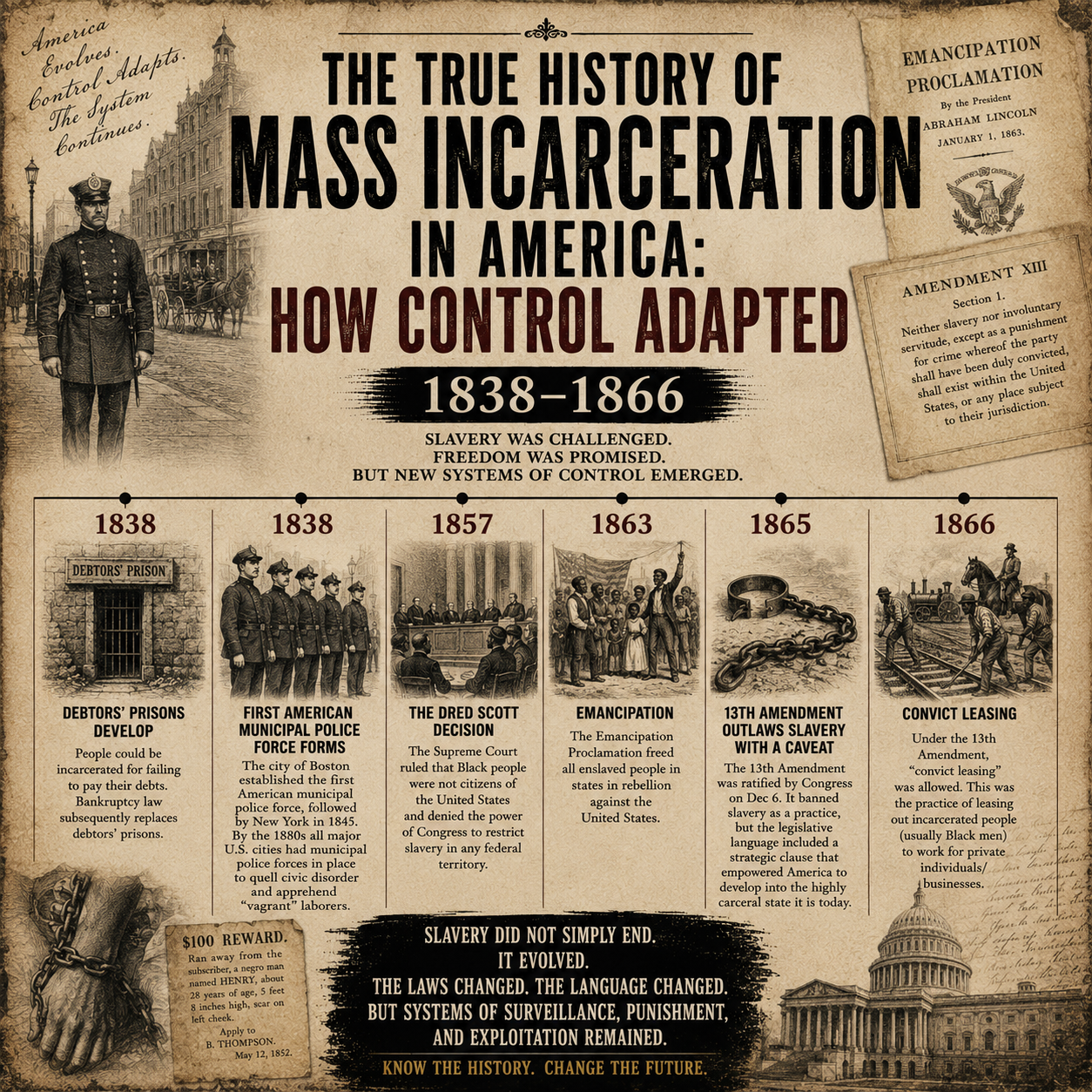
Part 2: 1838–1866
As part of our Justice in Action initiative, Avenues for Justice (AFJ) is continuing its examination of The True History of Mass Incarceration in America.
In Part One, we explored the period from 1619 to 1829, tracing the development of slavery, slave patrols, restrictive laws, and the emergence of the nation's first modern prison. We examined how systems of surveillance and punishment existed long before mass incarceration became a defining feature of American life.
The next chapter of this history takes us through one of the most transformative periods in American history: the decades leading up to and immediately following the Civil War.
At first glance, this era appears to tell a story of expanding freedom. Slavery was challenged, the Civil War was fought, and the Emancipation Proclamation and the 13th Amendment promised a new future.
But beneath those milestones, another story was unfolding. As America moved toward ending slavery, new systems emerged to regulate, monitor, and control Black life. Cities established professional police forces. Courts reinforced racial hierarchy through decisions like Dred Scott v. Sandford. And even as slavery was abolished, lawmakers left open a pathway that would allow forced labor to continue under another name.
The 13th Amendment ended slavery except as punishment for a crime.
In the years that followed, Southern states rapidly arrested newly freed Black people under vague and discriminatory laws. Once convicted, many were leased to private businesses, plantations, railroads, and industries through a system known as convict leasing.
The result was that freedom was often replaced by another form of forced labor. The institution of slavery had been dismantled, but the structures of control adapted. This period marks a turning point in the history of mass incarceration because it reveals a pattern that would repeat throughout American history. The reality that when one system of racial control ended, another often emerged in its place.
Understanding this history is about recognizing how laws, policies, and institutions created over generations continue to shape our society.
At Avenues for Justice, we have spent 47 years working alongside young people whose lives have been shaped by these systems. We know that incarceration is not simply the result of individual choices. It is also the result of policies, institutions, and economic interests that have been built over generations.
Real change requires more than awareness. It requires the courage to challenge systems that continue to profit from incarceration, the integrity to confront uncomfortable truths, and the willingness to invest in approaches that create opportunity rather than punishment.
That is the work of Avenues for Justice. And that is why this history matters.