Avenues for Justice
100 Centre Street, Room 1541
New York, NY 10013
info@avenuesforjustice.org
©Copyright 2022 Avenues for Justice. All rights reserved.


When we talk about mental health most people focus on what happened to someone or how they cope. But for many Black and Brown communities, mental health cannot be understood without also looking at generational trauma. This is what we experience in our work with young people at Avenues for Justice (AFJ).
Generational trauma refers to the emotional, psychological, and physiological impact of trauma that is passed down from one generation to the next. It connects to what happened to your parents, your grandparents, and the environments they navigate. Over time, these experiences shape how families live, how communities function, and how individuals experience the world.
Trauma can be the result of repeated exposure to violence, fear, loss, stress, and instability. It can live in the body and in the nervous system and it carries forward. Consider a Black or Brown youth who grew up in New York City and who has an incarcerated parent. Their earliest memories of them are in a visiting room. That experience can bring feelings of confusion, abandonment, and isolation. At the same time, that child may be growing up in a household under financial strain, in a neighborhood that is over-policed, and in an environment that feels unsafe. This reflects the lived experiences of some of the young people we work with at Avenues for Justice.
The parent who is currently incarcerated may have grown up witnessing many of these same conditions. They experienced exposure to violence, limited access to health care,, and schools and systems that did not support their growth. And their parents before them may have lived through segregation in the Jim Crow South, where Black families were systematically excluded from economic mobility and stability, prompting a move to places like New York City in search of better opportunities. But even there, systems of oppression continued to shape daily life, making it difficult to find meaningful work, build stability, and fully access opportunity within their own communities.
Generational trauma is experienced through conditions that persist over time. It’s also important to understand that trauma is also shaped by the environment. Living in a community where gun violence is present, where sirens are constant, where neighbors are lost to incarceration or death, where access to healthcare, quality education, and economic opportunity is limited. These are all forms of chronic stress and that affects how the brain and body respond. It can lead to anxiety, depression, hypervigilance, and difficulty trusting others or systems.
And yet, these experiences are often misunderstood or minimized in the media. Instead of being recognized as responses to trauma, behaviors are labeled as “problematic,” “defiant,” or “disengaged.” When the deeper context should be the history, the systems, the accumulated impact. But it is left out of the conversation.
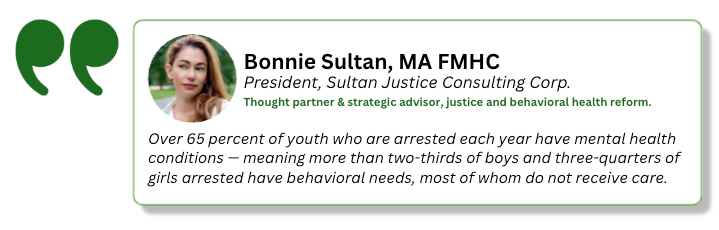
At Avenues for Justice, we see this reality every day. The young people we work with are not disconnected from their circumstances. Their experiences reflect not just individual choices, but environments shaped by decades of inequity. Our mental health partner Bonnie Sultan, whose work centers on Alternatives to Incarceration and community-based solutions for young people, puts it this way:
"Avenues for Justice is a unique bright spot of hope for young people. Walking through the door at AFJ, one enters a trauma-informed and supportive space filled with murals, motivated staff, smiling faces, and invested partners, all with one unifying mission — to create a more just world for young people by making alternatives to incarceration, and not jail, the norm. AFJ offers a safe and welcoming environment for all. Meeting Participants and hearing their stories is nothing less than motivational and inspiring. You'll meet young people who come back long after their mandated program was completed. Participants will tell you: in these rooms they feel safe, are happy, know they are heard, and gain the confidence to be themselves."
If we are serious about addressing mental health, we must be willing to name and understand generational trauma and create the conditions for people to speak about these experiences without shame. It also requires a deeper investment in solutions that address the root causes shaping these realities over time.