

Avenues for Justice
100 Centre Street, Room 1541
New York, NY 10013
info@avenuesforjustice.org
©Copyright 2022 Avenues for Justice. All rights reserved.


One of Avenues for Justice's (AFJ) greatest strengths has always been the people delivering our message. While it is not a requirement for every Court Advocate to share lived experiences with the young people they mentor, there is something uniquely powerful that happens when they do. Connections are made, trust forms and walls come down faster. And for a young person standing at a crossroad, seeing someone who has walked a similar path and found their way through can make all the difference.
This is the foundation of AFJ's credible messaging approach, and it is embodied every day by two members of our Court Advocacy team: Brian, Manager of Court Advocacy & Outreach, and Messiah, Court Advocate for both the Lower East Side and Harlem.
“Brian and Messiah uniquely provide authentic and empathetic support, transforming their past challenges into strength-based mentorship for our youth and young adults. Seeing someone who has lived through similar experiences and is now in a positive position provides hope to AFJ Participants.” ~ AFJ’s Executive Director, Liz Frederick
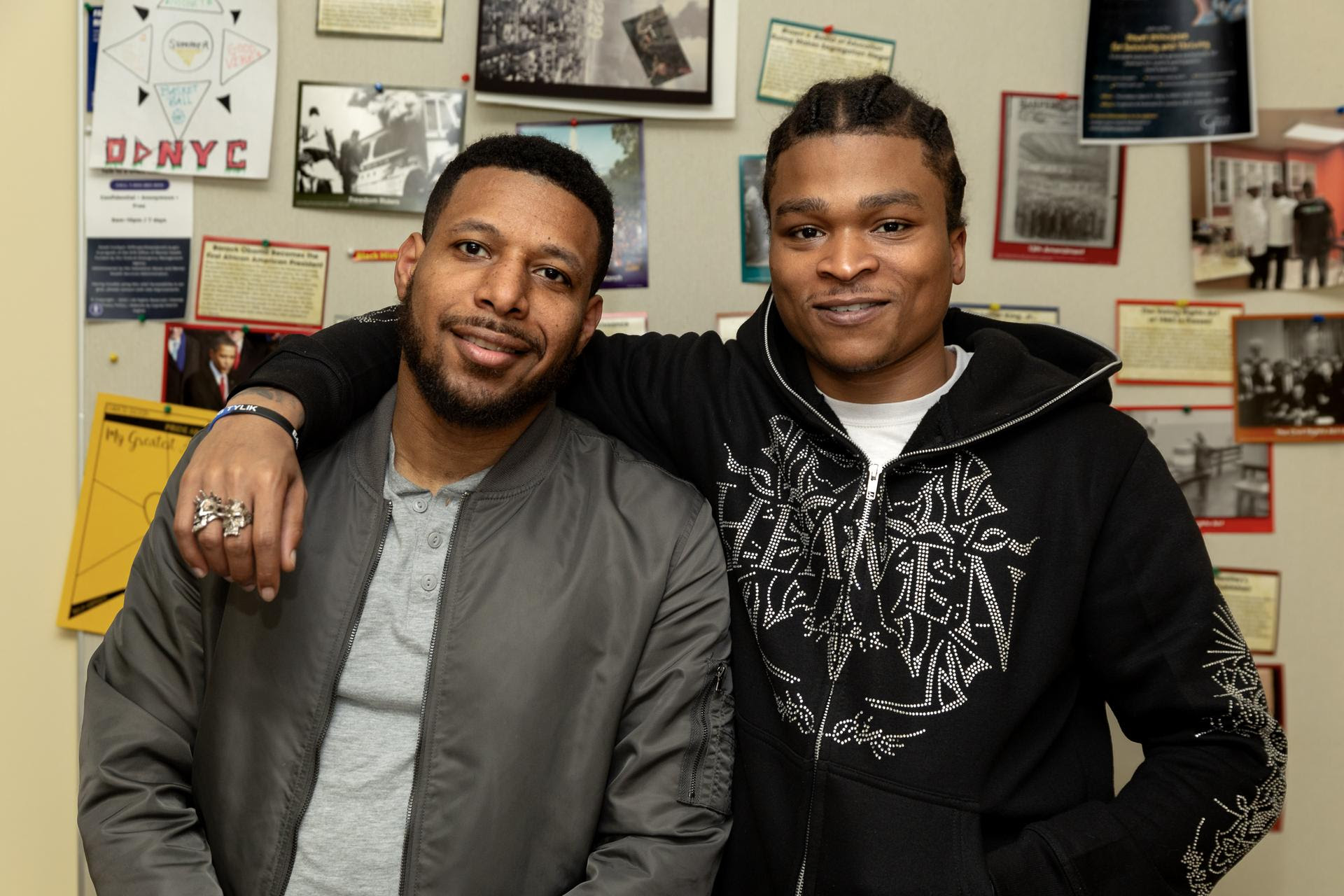
Brian came to AFJ in the summer of 2019, recruited by Chief Program Officer, Gamal Willis. Before joining AFJ, he had directed the Teen Center at the Bedford-Stuyvesant Police Athletic League and supported high school student publishing through Teachers & Writers Collaborative. But the foundation of Brian’s work at AFJ runs much deeper than his resume.
Brian grew up in East New York navigating many of the same pressures that bring young people into contact with the legal justice system today: lack of access to resources, substance abuse, press pressure, generational trauma and over policing. At eighteen, an arrest led to a sentence of probation, an outcome that kept his future intact. He went on to attend Howard University and build a career working with young people. Had the outcome involved jail time, his trajectory could have looked entirely different.
Brian is very clear about what that means. Given where he grew up and what he was surrounded by, he considers himself one of the lucky ones. Several of his childhood friends were less fortunate---lost to violence or to incarceration. That awareness sits heavily with him in every interaction he has with AFJ Participants. At AFJ, he finds himself in many of his Participants, and his Participants see themselves in him.
That connection drives everything he does. As Manager of Court Advocacy & Outreach, Brian has spent the past several years expanding AFJ's service track and reach across all five boroughs, building a digital referral and intake system, and developing tools to track Participant engagement and program incentives. In 2026, he is spearheading an organizational change in service design by splitting Court Advocacy into two dedicated tracks: one for Alternatives to Incarceration (ATI) Participants and one for Diversion Participants. This change ensures that services are tailored to each population's distinctive legal and advocacy needs.
He is also the longtime facilitator of one of HIRE Up's most essential offerings: the Legal Rights & Responsibilities workshop, a weekly series he has led for five years. The workshop educates Participants on their legal rights, criminal law, the court process, and the collateral consequences of justice involvement. All incoming Participants are required to attend at least one session, and over 500 young people have come through in the past two years alone.
"Many of the young people we work with are navigating complex interactions with the legal system," Brian explains. "When Participants understand how the law works and what their rights are in encounters with police or the courts, they are better equipped to protect themselves, advocate for themselves, and move forward toward stability and opportunity."
Among the Participants who have inspired him most is Jily, who came to AFJ as a Diversion Participant over two years ago and has stayed connected to the program long after completing her court mandate. Despite significant obstacles, she has earned digital literacy certifications, completed three paid internships through AFJ's eight-week internship program, and graduated from high school. Brian has also celebrated watching his first-ever Participant, Malik, receive AFJ's Second Chance Award, and learning that another Participant, Tomie, was accepted to several four-year universities. These are the moments, he says, that make the work worth it.

Messiah joined AFJ two years ago, and in that time has become a cornerstone of both the HIRE Up and Court Advocacy programs. His path to this work was shaped by an experience that few can fully imagine and that he does not shy away from sharing: he was sent to prison at sixteen and was not released until he was forty.
He grew up in Harlem near 125th Street during the height of the crack epidemic. The early 1990s were a punishing time to be a young person in a challenging urban environment. It was the era of the Central Park Five, politicians branding juvenile offenders "super predators," and the since-rescinded three-strikes rule that required life sentences after three felony convictions. The convergence of his environment, the choices he made, and a political climate designed to incarcerate rather than rehabilitate meant that Messiah spent his most formative years behind bars.
After his release, he did not wait to find his purpose. He began working immediately in the ATI and credible messaging space, spending several years as a liaison between incarcerated teens and their families at Horizons juvenile detention center in the Bronx. Often working alongside single mothers, he helped them understand what their children were experiencing inside and how to prepare for who their child might be when they came home.
Six years after his release, Messiah joined the team at AFJ, where he has found that the program works because of something fundamental: it offers young people a sense of family and consistency at a moment when they need it most. "One of the primary reasons that people join the streets, gangs, or other questionable groups," he observes, "is because there is a sense of camaraderie that they are missing at home. By offering that in a healthy and positive setting at a critical point in their lives, it can satisfy that innate need for community."
As a credible messenger, Messiah has a signature way of making his experience land. With every new Participant he meets, he asks how old they are. Then he shares that he was incarcerated at sixteen and released eight years ago and asks them to guess his age. Most assume he is in his late twenties or early thirties. The reality stops them cold. That is exactly the point. "This isn't TV," he tells them. "This is your life, and if you don't take control of it, your freedom is not guaranteed."
One moment from the past two years stands out to Messiah above all others. A Participant named Michael, who had progressed from being in custody to ankle monitoring to managing his life with real independence, attended AFJ's annual Gala. It was his first time in that kind of environment. AFJ provided him with his first suit and shoes, and watching him get dressed up, step into the room, and carry himself with visible pride was, for Messiah, a distillation of what this work is really about.
Beyond his one-on-one advocacy, Messiah co-leads two of AFJ's newer programmatic offerings. He helped launch AFJ's first Gun Violence Prevention cohort, which provides a structured space for Participants to reflect on decision-making, consequences, and their relationships with their communities. And alongside Dr. Dennis Ibude, he co-leads the Leadership Council, a ten-week program in which cohorts of five to eight Participants work through a framework of leadership development, covering punctuality, integrity, conflict resolution, project management, and facilitation. Participants who complete the course are then invited to help guide the next cohort, turning graduates into mentors.
In 2026, the Gun Violence Prevention cohort will expand to include a hybrid and virtual component, broadening its reach to Participants who might not otherwise be able to access it in person.
"Having credible messengers on AFJ's staff is extremely important," Messiah reflects. "Being able to connect with someone who has lived experience creates trust and relatability. It allows Participants to see a real example of what is possible and believe that change is achievable."
Brian, who works alongside Messiah every day, puts it simply: "Messiah is grounded, empathetic, and invested in steering our young people in a direction that he didn't have himself. He has a gift for perceiving exactly what a young person needs from him."
As we move into the second quarter of 2026, the Court Advocacy team is growing with new program tracks, expanded cohorts, and a deepening commitment to the credible messaging model that has defined this work from our incorporation. For Brian and Messiah, the mission remains the same as it has always been: show up, tell the truth, and give young people a reason to believe that a different future is possible.