

Avenues for Justice
100 Centre Street, Room 1541
New York, NY 10013
info@avenuesforjustice.org
©Copyright 2022 Avenues for Justice. All rights reserved.


Ten years after graduating from Avenues for Justice (AFJ), Kenny’s story shows what can happen when young people have opportunities, trusted relationships, and a community that continues to believe in them.
When Kenny talks about growing up in the Bronx, he remembers a neighborhood where being on guard became part of everyday life. Getting to school could mean navigating the possibility of a confrontation. Walking to the corner store could feel unsafe.
Kenny did not think of his childhood as especially unusual. His mother worked hard as a single parent, his grandmother helped raise him, and he grew up playing sports. His father was incarcerated for much of his childhood.
“It was kind of just normal,” Kenny remembers. “Everybody’s father was arrested or was incarcerated.” What was also normalized was the idea that a young man needed to be able to protect himself. At 17, Kenny was arrested and charged with possessing a weapon. He describes his thinking at the time as having a “twisted mindset,” but his decision was compounded from years of fear. He was living in an environment where he had seen people robbed or beaten up, sometimes for no apparent reason. He remembers constantly feeling in his teenage mind that he needed to protect himself.
Kenny spent several days at Rikers Island before his family was able to bail him out and that was when he was introduced to Avenues for Justice.
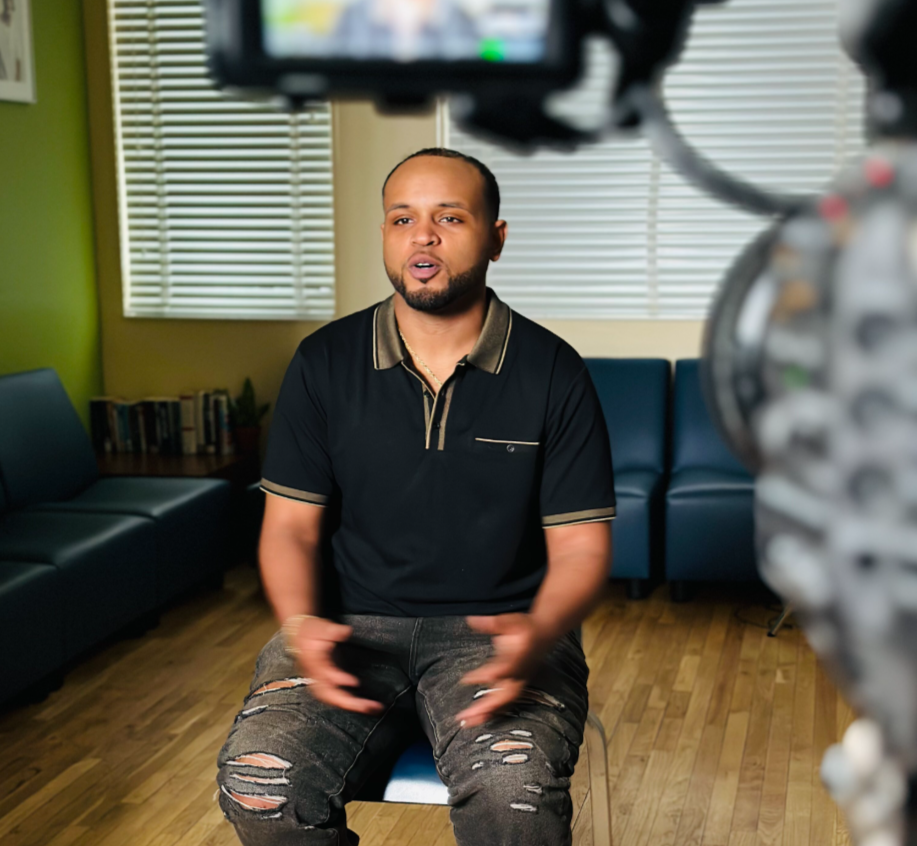
Kenny spent approximately five years with AFJ, and one of the things he remembers most clearly is that it never felt like a probation program. There were writing and reading classes, cooking, art and computer skills. There was food. There were activities. There were adults who expected something from him and held him accountable, including calling his home to make sure he was following his curfew. But there were also people who talked with him, listened to him and exposed him to experiences beyond what he had known.
“It felt like an after-school program,” Kenny says. “It was somewhere you wanted to go.” A young person who had already experienced incarceration did not walk into another environment built around punishment, surveillance and the assumption that he would fail. He entered a community that expected him to be accountable while also giving him opportunities to learn, build relationships and imagine something different for himself.
Kenny remembers AFJ mentor Michael Small whose conversations challenged the way he thought about conflict and safety. Michael would ask questions that initially seemed disconnected from the reality Kenny knew. Why did a confrontation have to end in violence? What other choices might have been available? The two came from different experiences, and that became part of what made the relationship valuable. Kenny began hearing another perspective. More importantly, he began to realize that the decisions he had once considered inevitable were actually choices he had the power to make.
For a teenager who had spent years believing that being prepared for violence was necessary for survival, discovering another way was not a small shift. It meant questioning ideas about safety, masculinity, strength and what it took to navigate the world around him. It meant understanding that walking away from a confrontation did not make him weak. It meant beginning to see that his future could be larger than the circumstances immediately surrounding him.
His family saw the change as well. Kenny became less interested in the activities and situations that had once consumed his attention. Even the AFJ rules that frustrated him as a teenager look different to him at 31. “At the time, I was definitely mad,” he says of the curfews and accountability. “But now that I’m older, I realize it really helped save me.”
Kenny has never been arrested again.
In 2016, Kenny was awarded with the Second Chance Award, now known as the Angel Rodriguez Award, for his successful participation in AFJ's court-mandated HIRE Up programming.
Kenny graduated from AFJ at 21. A decade later, he is still connected to the organization. That relationship speaks to something larger about what young people need not only when they are navigating the justice system, but throughout their lives. We all need people we can turn to for guidance, connections and opportunities, particularly when our circumstances change or we are trying to figure out what comes next.
After leaving AFJ, Kenny eventually opened a recording studio in the Bronx, which he operated for more than four years. His vision for the business was shaped in part by his own experience at AFJ. He wanted young people to have a safe place where they could record music, learn computer skills and be exposed to some of the same kinds of opportunities that had made a difference in his life.
Running the entire business himself eventually became overwhelming, and Kenny decided he wanted to return to a more traditional work environment. He reached out to AFJ’s Executive Director, Liz Frederick. Rather than placing him wherever there was a job opening, she asked what kind of work interested him and where he wanted to go next.
Today, he works as a doorman on Manhattan’s Upper East Side and also does construction work, both opportunities he obtained through Avenues for Justice. The construction work is helping him develop skills that could become particularly valuable because Kenny has not abandoned his dream of owning another recording studio. He hopes to return to it in the future, this time with more experience and skills that could help him build and remodel his own space.
Kenny’s experience is an important reminder that progress rarely happens in a straight line. People build something, change direction, encounter challenges, discover new interests and sometimes need help finding their next opportunity. Having people who know you, believe in you and are willing to open a door can make an enormous difference.
Kenny’s story reminds us that none of us builds a life entirely on our own. Opportunity matters. Trust matters. Having people who believe in us matters. And sometimes the difference between remaining defined by the circumstances around us and discovering what else is possible begins with having someone there to show us another way. More than a decade later, he is still building his future, still thinking about what comes next and still connected to the community that helped him imagine a different life.